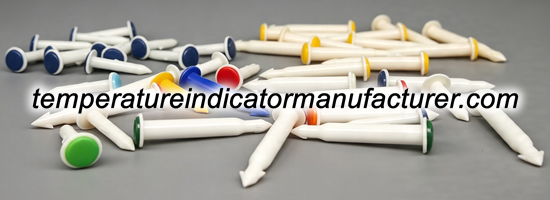
How Temperature Indicators Support Turkey Processing and Commercial Poultry Production
How Temperature Indicators Support Turkey Processing and Commercial Poultry Production
Turkey and poultry production operate at a scale where small improvements in process consistency can have a meaningful effect on the overall manufacturing workflow. For processors handling large volumes of poultry products, temperature indication is one of the practical tools used to support consistent preparation and production procedures.
Disposable temperature indicators are particularly useful where a simple, visible indication is preferred over a reusable measuring device. Their single-use design allows them to be incorporated into specific food applications without introducing additional equipment into the production process.
For poultry processors evaluating suppliers, the important question is not simply whether a temperature indicator is available, but whether the manufacturer can provide the right specifications, consistent production, bulk supply, and customization required for commercial operations.
Why Temperature Indication Matters in Turkey Processing
Turkey processing involves large products, high-volume production, and carefully controlled preparation procedures. Depending on the application, processors may need a practical way to indicate that a predetermined temperature point has been reached.
A disposable temperature indicator can provide a clear visual signal within the product application. This makes the device easy to understand and convenient for production environments where operators need straightforward indication rather than complicated instrumentation.
The value is particularly relevant when the same procedure must be repeated across large numbers of products. Consistent product specifications help processors maintain a standardized approach from one production batch to another.
Applications Across Commercial Poultry Production
Poultry temperature indicators can be used in a range of commercial applications involving turkey and chicken products. The exact configuration depends on the product, processing method, and temperature requirement.
- Turkey processing and roasting applications
- Chicken processing applications
- Prepared poultry products
- Ready-to-cook poultry products
- Frozen poultry product programs
- Commercial food manufacturing
This makes the product relevant not only to individual consumers but also to poultry companies that incorporate temperature indication into packaged or prepared food products.
What Poultry Processors Should Look for in a Temperature Indicator
Industrial buyers normally have different priorities from retail consumers. A poultry processing plant may require tens or hundreds of thousands of pieces over a purchasing cycle, making consistency and supply reliability just as important as the initial product specification.
Before selecting a supplier, buyers should consider the following factors:
- Activation temperature
- Activation accuracy
- Product size
- Material construction
- Production capacity
- Packaging requirements
- OEM customization capability
- Long-term supply stability
Activation Temperature Is an Application Decision
There is no single activation temperature suitable for every poultry application. Different products, preparation methods, and customer specifications can require different temperature settings.
A manufacturer serving professional poultry customers should therefore be able to offer multiple activation temperatures and, where appropriate, develop customized specifications.
This flexibility is particularly useful for processors producing different poultry products under the same purchasing program. Instead of adapting the production process to a fixed indicator, the supplier can work from the customer's required specification.
Accuracy and Production Consistency
For commercial food production, accuracy should be considered together with repeatability. A single product performing correctly does not provide enough information for an industrial buyer. The manufacturer must also maintain consistent performance across production batches.
Professional disposable temperature indicators can be manufactured to controlled activation specifications, with accuracy reaching approximately ±2°F depending on the product configuration and agreed requirements.
For a poultry processor, this consistency is important because the same product specification may be used repeatedly across large production runs.
Materials Used in Disposable Poultry Temperature Indicators
Material selection is another consideration for products intended for food-related applications. Buyers should be able to obtain clear information about the construction of the indicator and the materials used in its components.
A professional disposable temperature indicator may incorporate food-grade PA66 nylon for the housing and core, BPA-free components, food-extracted temperature sensing wax, and a precision metal spring mechanism.
Clear material information allows procurement and quality teams to evaluate products according to their own internal requirements and applicable market standards.
Bulk Supply for Poultry Processing Plants
Poultry processors rarely purchase temperature indicators as occasional consumer products. Their requirements are normally connected to production planning, packaging schedules, and recurring procurement.
For this reason, a suitable supplier should be capable of supporting bulk orders while maintaining stable specifications. Production capacity, lead-time management, repeat-order consistency, and communication all become important parts of the supplier relationship.
Direct communication with the manufacturing source can also simplify discussions about forecast quantities, technical changes, packaging, and future product requirements.
OEM Options for Turkey and Poultry Brands
Many poultry companies sell products under their own brands or supply private-label products to supermarkets and food distributors. In these situations, a standard generic product may not provide the presentation or specifications required by the customer.
OEM manufacturing can provide options such as:
- Custom activation temperatures
- Custom button head colors
- Logo-branded injection molding
- Custom blister card packaging
- Clear self-seal bag packaging
- Bulk industrial packaging
These options allow the same basic temperature indication technology to serve different commercial channels while maintaining a product configuration suited to each customer's requirements.
Why a Specialized Manufacturer Can Be Valuable
A temperature indicator is a small component, but its production involves several controlled elements. A manufacturer specializing in this product category can develop deeper knowledge of the materials, activation mechanism, assembly process, and quality requirements involved.
For an industrial poultry buyer, specialization can make technical communication more straightforward. It also provides a stronger basis for discussing customized temperatures, packaging formats, product sizes, and long-term production requirements.
From Poultry Processor to Finished Food Product
Temperature indicators can serve different roles depending on where they are incorporated into the food supply chain. A poultry processor may purchase them for use with its own products, while a food brand may require them as part of a retail-ready product or private-label program.
The common requirement is straightforward: the indicator needs to fit the intended application and perform consistently according to the agreed specification.
This is why professional sourcing should begin with the application rather than with a generic product name. The required temperature, size, packaging, quantity, and branding requirements should all be established before selecting the final configuration.
Questions Poultry Buyers Should Ask a Manufacturer
A procurement team can save time by establishing several basic points before starting a long-term supply relationship.
- What activation temperatures are available?
- What activation accuracy can be specified?
- What materials are used in the product?
- Can the product be customized for a specific poultry application?
- Can the manufacturer support bulk production?
- What OEM and packaging options are available?
- Does the manufacturer have experience with international B2B supply?
These questions help distinguish a specialized manufacturing partner from a supplier that simply resells a standard product.
Frequently Asked Questions
What temperature indicator is used for turkey processing?
Disposable temperature indicators with a specified activation temperature can be used for turkey processing and roasting applications. The appropriate activation point depends on the product and the customer's application requirements.
How do poultry processors use disposable temperature indicators?
They can be incorporated into poultry products or related food applications to provide a visible indication when the specified activation temperature is reached.
Can turkey temperature indicators be customized?
Yes. Professional manufacturers can provide customized activation temperatures, colors, sizes, branding, and packaging according to the project requirements.
Are disposable temperature indicators suitable for commercial poultry production?
Yes. Their single-use design and simple visual indication make them suitable for a range of commercial poultry and food production applications.
What accuracy can a disposable temperature indicator provide?
The activation accuracy depends on the product specification. Professionally manufactured models can achieve approximately ±2°F under specified conditions.
Can poultry processors buy temperature indicators in bulk?
Yes. Bulk production is an important supply model for poultry processors, food manufacturers, distributors, and other B2B customers.
Can a poultry company use its own brand on the indicator?
OEM options can include logo-branded injection molding and customized packaging, subject to the manufacturer's production capabilities and project requirements.
What materials are used in disposable poultry temperature indicators?
Depending on the model, materials can include food-grade PA66 nylon, BPA-free components, food-extracted temperature sensing wax, and a metal spring mechanism.
How should a poultry company choose a supplier?
The company should evaluate product specialization, activation specifications, material information, manufacturing experience, OEM capability, bulk production capacity, and long-term supply reliability.
DISCLAIMER
"Pop-up timer" is a commonly used descriptive industry term for a type of disposable cooking temperature indicator. It may refer to the functional design or operating principle of such products and does not by itself identify a specific manufacturer or brand.
PopNReady™ is an independent OEM brand of disposable cooking temperature indicators manufactured by LIOU Manufacturing . We are an independent factory-direct manufacturer and are not affiliated with any other brand or manufacturer unless expressly stated.