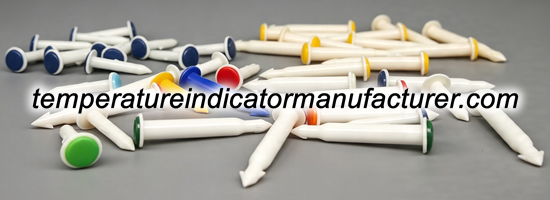
How to Choose a Disposable Temperature Indicator for Frozen Poultry Products
How to Choose a Disposable Temperature Indicator for Frozen Poultry Products
Frozen poultry products are manufactured and sold through a wide range of commercial channels, from large food processors and retail brands to food service suppliers and private-label programs. When a temperature indicator is included with a poultry product, the choice of indicator should be based on the actual product application rather than simply on the fact that the product is frozen.
For purchasing teams, several factors deserve attention: the required activation temperature, product dimensions, intended use, packaging format, material construction, and expected order volume.
Understanding these factors makes it easier to select a disposable temperature indicator that fits the product and the production process.
Why Frozen Poultry Products May Require Different Indicator Specifications
Frozen poultry products can vary considerably in size, preparation method, packaging format, and intended use. A turkey product prepared for a retail customer may have very different requirements from a smaller chicken product supplied to a food service operator.
The temperature indicator therefore needs to be selected according to the application. A standard model may be suitable for one product but not necessarily for another.
For manufacturers, this is one reason why having access to multiple activation temperatures and product configurations can be valuable.
Common Frozen Poultry Applications
Disposable temperature indicators can be considered for a variety of poultry-related products and commercial applications, including:
- Frozen turkey products
- Frozen chicken products
- Whole poultry products
- Ready-to-cook poultry
- Retail poultry products
- Private-label poultry products
- Prepared food products containing poultry
The appropriate indicator configuration depends on the requirements of the individual product and the way the indicator will be used.
Start with the Intended Temperature Requirement
One of the first questions a buyer should ask is what temperature the indicator is expected to respond to.
Activation temperature is a product specification rather than a universal feature. Different food applications can require different activation points, so manufacturers serving professional customers should be able to offer a range of specifications.
For an OEM project, the required activation temperature should be established before the final product configuration is selected.
Why Product Size Matters
The physical size of a temperature indicator can also influence product selection.
Larger poultry products may require a different indicator configuration from smaller portions. The available space within or around the food product and its packaging should therefore be considered during product selection.
For large-volume programs, buyers should confirm the dimensions of the indicator together with the intended application before placing a production order.
Consider the Packaging Format
Packaging is an important part of a commercial temperature indicator program.
An industrial poultry processor may purchase indicators in bulk for production use, while a retail food brand may require an individually presented product that forms part of the finished consumer package.
Possible packaging approaches include:
- Bulk industrial packaging
- Clear self-seal bag packaging
- Blister card packaging
- Custom retail packaging
- OEM branded packaging
The best format depends on how the indicator enters the production and distribution process.
Food-Grade Materials Should Be Clearly Specified
For products associated with food applications, buyers should obtain clear information about the materials used in the indicator.
Disposable temperature indicators can be manufactured using food-grade PA66 nylon for the housing and core, BPA-free components, food-extracted temperature sensing wax, and a metal spring mechanism.
Material specifications should be reviewed by the customer's own quality and compliance teams according to the intended application and applicable market requirements.
Accuracy and Consistency in Poultry Applications
Temperature indication performance should be considered from both an accuracy and consistency perspective.
For commercial buyers, it is not enough for an individual indicator to perform correctly. Production batches should also maintain consistent specifications.
Professional disposable temperature indicators can be manufactured to controlled activation specifications, with some models achieving approximately ±2°F activation accuracy according to the agreed product specification.
For recurring poultry production, consistent performance can be particularly important because the same indicator specification may be used across large numbers of products.
OEM Temperature Indicators for Frozen Poultry Brands
Frozen poultry companies frequently operate private-label programs or supply products to supermarket chains, distributors, and food service customers.
In these cases, OEM manufacturing can provide greater flexibility than purchasing a standard retail product.
Depending on the project, customization can include:
- Activation temperature
- Indicator size
- Button head color
- Logo injection molding
- Blister card design
- Clear self-seal bag packaging
- Bulk packaging configuration
This allows the temperature indicator to be incorporated into a broader product and packaging strategy.
Bulk Purchasing Considerations
Frozen poultry manufacturers normally purchase according to production requirements rather than individual consumer demand. This makes supply reliability an important part of the purchasing decision.
Before selecting a supplier, procurement teams should confirm:
- Available production capacity
- Minimum order requirements
- Lead time
- Repeat-order consistency
- Packaging options
- OEM capabilities
- Export experience
A supplier that can support both initial orders and repeat production is often more useful than a source focused only on one-time transactions.
Why Direct Manufacturer Supply Can Matter
For an industrial buyer, working directly with a manufacturer can simplify communication about specifications and customization.
Instead of communicating through several intermediaries, the buyer can discuss activation temperature, materials, dimensions, packaging, production schedules, and quality requirements directly with the manufacturing source.
This can be particularly useful when a frozen poultry company is developing a new product or changing an existing packaging program.
A Practical Selection Checklist
Before approving a disposable temperature indicator for a frozen poultry application, buyers can use a simple checklist:
- Define the intended application.
- Confirm the required activation temperature.
- Confirm the required accuracy.
- Check product dimensions.
- Review material specifications.
- Determine the required packaging format.
- Estimate initial and recurring quantities.
- Confirm OEM requirements if applicable.
- Evaluate the manufacturer's production capability.
This approach keeps the purchasing decision focused on the actual application instead of treating all disposable temperature indicators as interchangeable products.
Frequently Asked Questions
Can disposable temperature indicators be used with frozen poultry products?
Yes. Disposable temperature indicators can be used in various poultry-related applications, including frozen turkey and chicken products, depending on the intended use and product specification.
How do I choose a temperature indicator for poultry packaging?
Start with the intended application, required activation temperature, product size, packaging format, and quantity. OEM requirements should also be considered if the indicator will be part of a branded product.
Can the activation temperature be customized?
Yes. Professional manufacturers can provide different activation temperatures and customized specifications for suitable applications.
Can poultry companies order temperature indicators in bulk?
Yes. Bulk production is commonly used by poultry processors, food manufacturers, distributors, and private-label food companies.
What packaging options are available?
Depending on the project, options can include bulk packaging, clear self-seal bags, blister cards, and other OEM packaging formats.
Can a frozen poultry brand use its own logo?
OEM manufacturing can support options such as logo injection molding and customized packaging, subject to the product and production requirements.
What should a poultry manufacturer ask a supplier before ordering?
The buyer should confirm activation temperature, accuracy, dimensions, materials, packaging, production capacity, lead time, and OEM capabilities.
Why is supplier consistency important for frozen poultry products?
When an indicator is used repeatedly across large production runs, consistent product specifications help maintain a standardized purchasing and production program.
DISCLAIMER
"Pop-up timer" is a commonly used descriptive industry term for a type of disposable cooking temperature indicator. It may refer to the functional design or operating principle of such products and does not by itself identify a specific manufacturer or brand.
PopNReady™ is an independent OEM brand of disposable cooking temperature indicators manufactured by LIOU Manufacturing . We are an independent factory-direct manufacturer and are not affiliated with any other brand or manufacturer unless expressly stated.