Disposable Temperature Indicator vs. Reusable Thermometer: Which Is Better for Commercial Food Applications?
Disposable Temperature Indicator vs. Reusable Thermometer: Which Is Better for Commercial Food Applications?
When food manufacturers evaluate temperature measurement products, the choice is not always between one brand and another. In many cases, the more important decision is whether the application calls for a reusable thermometer or a disposable temperature indicator.
Both product types can have a useful role in food preparation and production, but they are designed around different operating methods. A reusable thermometer is generally intended to measure temperature repeatedly, while a disposable temperature indicator is designed for a specific single-use application and provides a predetermined visual indication.
For commercial food businesses, understanding this difference can make product selection much easier.
How the Two Product Types Work Differently
A reusable thermometer is normally a measuring instrument. It can be used repeatedly and may provide a numerical temperature reading through a mechanical, digital, or electronic system.
A disposable temperature indicator works differently. Instead of providing a continuously changing temperature reading, it is designed to activate at a specified temperature and provide a visible indication.
This difference means that the two products should not necessarily be judged by the same criteria.
When a Reusable Thermometer Makes Sense
Reusable thermometers can be useful when an operator needs to measure different temperatures repeatedly during a food production or preparation process.
For example, a production employee may need to check multiple products or locations and record numerical readings as part of an internal procedure.
In these situations, the ability to use the same measuring device repeatedly can be valuable.
When a Disposable Temperature Indicator Makes Sense
A disposable temperature indicator is better suited to applications where a simple visual indication at a predetermined temperature is sufficient.
The device can remain with the food product rather than being repeatedly inserted into different products.
This can make the format particularly relevant to:
- Turkey products
- Chicken and other poultry products
- Meat products
- Ready-to-cook foods
- Retail-ready food products
- Private-label food products
- Selected commercial food applications
The suitability of the product depends on the specific food application and the temperature requirement established by the manufacturer.
Single-Use Design Can Simplify the Workflow
One of the main differences between the two product categories is what happens after use.
A reusable thermometer has to be removed, cleaned, maintained, stored, and prepared for its next measurement. A disposable indicator is intended for one application and is then discarded.
For a food product that is being prepared, packaged, or sold with the indicator as part of the product experience, this can be a practical advantage.
The operator does not need to recover the device for another product because the indicator is intended to remain associated with the individual application.
Why This Difference Matters in Commercial Food Production
Commercial food production is different from occasional household cooking. A manufacturer may process large quantities of products under standardized procedures.
In such an environment, the ideal temperature indication method depends on the production objective.
If the operator needs a numerical measurement at multiple points, a reusable thermometer may be appropriate.
If the product itself benefits from a simple visual indication at a predetermined temperature, a disposable temperature indicator may provide a more practical format.
The two products can therefore complement rather than replace one another.
Accuracy Should Be Considered in Context
It is tempting to compare the two products only by asking which one provides the most precise numerical reading. That comparison can miss the purpose of a disposable indicator.
A disposable temperature indicator is designed around a defined activation point. For example, a manufacturer may specify an activation temperature and an acceptable activation accuracy for a particular model.
Professional disposable indicators can be manufactured to controlled specifications, with some configurations achieving approximately ±2°F activation accuracy.
The appropriate product should therefore be selected according to the required application rather than assuming that a numerical display is always necessary.
Disposable Does Not Mean One Specification Fits Every Application
Another common misconception is that disposable temperature indicators are generic products with only one available configuration.
In commercial manufacturing, different applications can require different specifications.
Depending on the manufacturer, options can include:
- Different activation temperatures
- Different product sizes
- Different button head colors
- Customized product configurations
- OEM branding
- Bulk packaging
- Retail packaging
This flexibility allows a single-use temperature indicator platform to serve different food manufacturing programs.
Food Applications and Product Integration
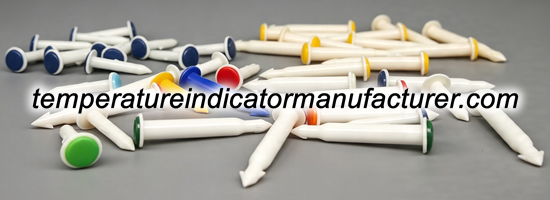
Reusable thermometers are generally treated as separate tools used by an operator. A disposable temperature indicator can instead become part of the food product or its preparation package.
This distinction can be important for retail-ready poultry and meat products.
For example, a food manufacturer may want the consumer to have a simple visual indication without requiring the consumer to own or operate a separate measuring device.
In such an application, the indicator is not merely a replacement for a reusable thermometer. It is a different type of product designed around a different user experience.
Packaging Considerations
When a disposable indicator is supplied as part of a commercial food product, packaging becomes an important consideration.
Industrial buyers may purchase loose indicators in bulk for their own production process. Retail-oriented programs may instead require a more finished presentation.
Available formats can include:
- Bulk loose packaging
- Clear self-seal bag packaging
- Blister card packaging
- Custom OEM packaging
- Private-label packaging
The right format depends on whether the customer is using the indicator as a production component, a packaged accessory, or part of a retail product.
Material and Food-Application Requirements
For food-related applications, material information should be part of the supplier evaluation process.
Depending on the model, disposable temperature indicators can use food-grade PA66 nylon for the housing and core, BPA-free components, food-extracted temperature sensing wax, and a precision metal spring.
Food manufacturers should review the complete material and compliance documentation with their own quality and regulatory teams before approving a product for a specific application.
What About Cross-Use Between Different Products?
A reusable thermometer can be used across multiple products when appropriate cleaning and operating procedures are followed.
A disposable indicator follows a different model: one indicator is intended for one application.
For food companies, the choice should therefore be based on the production process, the intended use, and the required workflow rather than on the assumption that one product category is universally better.
Bulk Purchasing: Comparing Total Practical Value
For a commercial buyer, unit price is only one part of the purchasing decision.
A reusable thermometer may have a higher initial cost but can be used repeatedly. A disposable indicator has a recurring per-unit cost because each application requires a new device.
At the same time, disposable indicators can eliminate some of the operational requirements associated with recovering and reusing a measuring device.
The appropriate comparison is therefore the total cost and operational value within the customer's specific workflow.
How Procurement Teams Should Compare the Two
A simple purchasing framework can help determine which format is more appropriate.
| Consideration | Disposable Temperature Indicator | Reusable Thermometer |
|---|---|---|
| Intended use | Single application | Repeated measurements |
| Temperature indication | Predetermined activation point | Repeated temperature measurement |
| Product integration | Can remain with the application | Normally used as a separate tool |
| Reuse | No | Yes |
| Retail product integration | Suitable for selected applications | Generally less suited to remaining with the product |
| OEM customization | Available for suitable manufacturing programs | Depends on the instrument manufacturer |
Questions to Ask Before Choosing a Product
Before making a purchasing decision, food manufacturers should answer several basic questions:
- Does the operator need a numerical temperature reading?
- Does the product require an indicator that remains with it?
- Is a predetermined activation temperature sufficient?
- Will the product be used once or repeatedly?
- Does the application require OEM customization?
- Is the indicator intended for bulk production or retail packaging?
- What quantity will be required over the production cycle?
These questions usually provide a clearer basis for selecting the appropriate product category than simply comparing prices.
Frequently Asked Questions
Is a disposable temperature indicator the same as a reusable thermometer?
No. A disposable temperature indicator is designed for single-use temperature indication at a predetermined activation point, while a reusable thermometer is generally designed for repeated temperature measurement.
Are disposable temperature indicators less accurate than reusable thermometers?
The products use different measurement approaches, so accuracy should be evaluated according to the intended function. Disposable indicators are manufactured to defined activation specifications, and some configurations can achieve approximately ±2°F.
Why would a food manufacturer choose a disposable indicator?
A disposable indicator can provide a simple visual indication without requiring the user to repeatedly measure, clean, and reuse a separate thermometer.
Can disposable indicators be used for poultry and meat products?
Yes. Suitable configurations can be used for turkey, chicken, meat, and other food applications where predetermined temperature indication is appropriate.
Can a disposable temperature indicator be customized?
Yes. Depending on the manufacturer and project, activation temperature, size, color, branding, and packaging can be customized.
Are disposable temperature indicators suitable for B2B bulk purchasing?
Yes. They are available for bulk supply and can be manufactured for recurring food production and OEM programs.
Which is cheaper, a disposable indicator or a reusable thermometer?
There is no universal answer. A reusable thermometer can be reused many times, while a disposable indicator has a cost for each application. Commercial buyers should compare the total cost and workflow requirements of their specific application.
Can a disposable temperature indicator replace every type of thermometer?
No. The two product categories serve different purposes. A disposable indicator is appropriate when a predetermined visual indication meets the application's requirements, while a reusable thermometer is more suitable when repeated numerical measurement is required.
DISCLAIMER
"Pop-up timer" is a commonly used descriptive industry term for a type of disposable cooking temperature indicator. It may refer to the functional design or operating principle of such products and does not by itself identify a specific manufacturer or brand.
PopNReady™ is an independent OEM brand of disposable cooking temperature indicators manufactured by LIOU Manufacturing . We are an independent factory-direct manufacturer and are not affiliated with any other brand or manufacturer unless expressly stated.